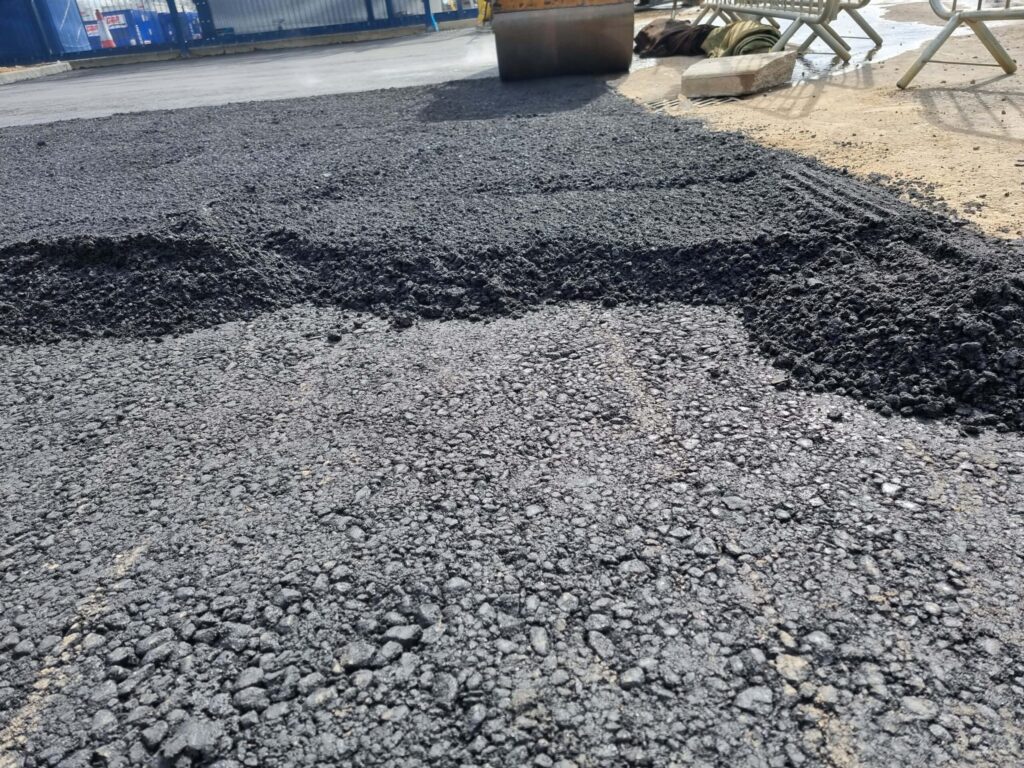
Can Your Existing Tarmac Driveway Be Saved Without Full Replacement?
An aging or damaged tarmac driveway does not automatically need to be completely replaced. Cracks, worn patches, minor depressions and localised deterioration can make a surface look as though it has reached the end of its useful life, yet much of the underlying construction may still be stable and serviceable.
For property owners in Norwich, Norfolk, the key is establishing how deep the deterioration extends. If problems are limited to particular sections and the supporting structure remains sound, professional repairs or resurfacing may restore the driveway without removing and reconstructing the entire surface. A proper assessment is therefore essential before deciding how much work is genuinely necessary.
When Can an Existing Tarmac Driveway Be Preserved?
Whether a tarmac driveway can be saved depends primarily on the condition of the existing surface and the construction beneath it.
Tarmac works as part of a layered system. The visible surface provides the finished driving area, while the supporting materials underneath help distribute vehicle loads and maintain stability. Surface deterioration can sometimes be repaired successfully, but problems caused by widespread movement or failure beneath the tarmac may require a more extensive approach.
Understanding that distinction prevents a driveway from being replaced unnecessarily while also avoiding repairs that fail to address deeper problems.
Surface Appearance Does Not Tell the Whole Story
Older tarmac naturally changes in appearance.
The surface may fade, become less uniform or show evidence of years of vehicle use. These visual changes do not necessarily mean the driveway has lost its structural integrity.
What matters more is whether the surface remains stable and whether defects are localised.
A tired-looking driveway that remains firm and generally level can present a very different situation from one experiencing widespread cracking, sinking and movement.
Professional assessment focuses on performance rather than appearance alone.
Small Cracks May Be Suitable for Repair
Cracks are among the most common signs of deterioration in tarmac.
A small number of localised cracks does not necessarily justify full replacement. Where the surrounding surface remains stable, appropriate repair can help prevent water entering the opening and reduce the likelihood of further deterioration.
However, the pattern of cracking matters.
One isolated crack should be considered differently from widespread interconnected cracking across substantial areas. The latter can indicate that deterioration extends beyond the upper surface.
Identifying why the cracking has developed is therefore important before deciding on the repair.
Localised Potholes Do Not Always Mean the Whole Driveway Has Failed
A pothole can develop where one section of tarmac has weakened and broken away.
If the deterioration is confined to a particular location, the damaged material can potentially be removed and the affected section reconstructed appropriately while the surrounding driveway remains in place.
The condition around the pothole should always be assessed.
If neighbouring tarmac remains firm and well supported, a targeted repair may be suitable. If the surrounding surface is also cracking, breaking apart or moving, the problem may be more extensive than the visible hole suggests.
Worn Areas Can Sometimes Be Addressed Without Reconstruction
Repeated vehicle movements can gradually wear particular sections of a driveway more heavily than others.
Areas where vehicles regularly turn, stop or manoeuvre may show deterioration sooner than sections experiencing lighter use.
When this wear remains largely confined to the surface, it may be possible to improve the driveway without completely reconstructing it.
The important consideration is whether the supporting construction underneath remains capable of providing a stable foundation.
Resurfacing May Be Suitable When the Existing Base Is Sound
There are circumstances where the existing driveway remains structurally serviceable but the upper surface has deteriorated more extensively.
In these situations, resurfacing may provide an alternative to complete replacement, subject to the condition and suitability of the existing construction.
The current driveway must first be assessed carefully. Covering an unstable or badly deteriorated surface without correcting underlying weaknesses is unlikely to provide a dependable result.
Preparation is therefore just as important as the new surface itself.
Depressions Need to Be Investigated
Low areas or depressions can indicate that movement has occurred beneath the tarmac.
A shallow depression should not simply be treated as a cosmetic issue, particularly if it has appeared gradually or continues to become more noticeable.
The cause needs to be established.
If settlement is confined to one section, it may be possible to reconstruct that area while preserving the remainder of the driveway. Where settlement occurs throughout the surface, a broader solution may be required.
Standing Water Can Reveal Changes in the Surface
A driveway that previously drained effectively but has started holding puddles may have experienced changes in level.
Water naturally collects at low points, so persistent standing water can highlight settlement or deformation that is not immediately obvious in dry conditions.
Correcting the problem requires more than simply covering the puddled area.
The levels, surrounding surface and reason for the depression should be considered together. This allows any repair to restore both surface stability and appropriate drainage.
Damaged Edges Can Often Be Localised
Driveway edges can deteriorate where they are repeatedly driven over or where support has become inadequate.
Small sections may begin cracking or breaking away while the central driveway remains in good condition.
Where the deterioration has not progressed far, targeted edge repairs may help preserve the wider surface.
However, continuing edge failure should be investigated because unsupported areas can gradually deteriorate further into the main driveway.
Previous Repairs Do Not Automatically Mean Replacement Is Needed
An older tarmac driveway may contain several previous repair areas.
This is not necessarily a problem. Well-executed repairs can preserve an otherwise serviceable surface for a considerable period.
The more important question is how those repairs are performing.
If they remain stable and new defects are occasional and localised, further targeted work may still be appropriate. If previous repairs repeatedly deteriorate or new problems continually develop around them, the condition of the wider driveway deserves closer assessment.
The Pattern of Damage Provides Important Clues
Individual defects should not be assessed in isolation.
Several problems occurring within the same area can indicate that they share an underlying cause. For example, cracking, settlement and standing water may all result from movement within one section.
Signs worth considering together include:
- Cracks that are widening or spreading
- Localised potholes
- Loose or breaking tarmac
- Sunken sections
- Persistent standing water
- Deteriorating driveway edges
- Movement around previous repairs
- Uneven areas becoming progressively worse
Understanding the pattern helps determine whether the driveway requires targeted repair, resurfacing or more extensive reconstruction.
Why the Base Is So Important
The visible tarmac is only the upper part of the driveway construction.
The supporting layers underneath play a major role in distributing loads and keeping the surface stable. If those layers remain sound, there may be considerable value in preserving them rather than reconstructing the entire driveway.
If the base has become unstable across substantial areas, surface repairs alone are less likely to provide lasting results.
This is why professional assessment needs to consider both the visible deterioration and what that deterioration may indicate about the construction beneath it.
Local Repairs Can Preserve Sound Sections
Where deterioration is limited, repairing only the affected areas allows serviceable sections of the driveway to remain undisturbed.
This can be particularly appropriate where most of the tarmac remains stable and only specific areas have been affected by cracking, local settlement or surface breakdown.
The objective should be to remove or repair deterioration sufficiently to restore dependable performance.
Simply covering visible damage without addressing its cause is different from carrying out a properly prepared local repair.
When Might Resurfacing Be Considered?
Resurfacing can be relevant when deterioration affects a larger proportion of the upper surface but the existing driveway still provides a suitable foundation.
It can create a renewed driving surface while retaining appropriate parts of the existing construction underneath.
However, resurfacing is not a way to conceal structural problems.
Any failed, unstable or significantly damaged areas need to be identified and addressed as part of the preparation. The suitability of the existing levels and drainage should also be considered before a new surface is installed.
When Are Repairs Less Likely to Be Sensible?
Saving an existing tarmac driveway becomes more difficult when deterioration is widespread rather than localised.
Examples can include extensive interconnected cracking, movement across numerous sections, widespread surface breakup or repeated settlement throughout the driveway.
If substantial areas of the supporting construction are no longer stable, continually repairing individual surface defects may provide limited long-term benefit.
At this stage, a professional assessment can establish whether enough of the existing construction remains serviceable to justify preservation.
Avoid Repeatedly Treating the Same Symptom
If the same crack, depression or repaired section repeatedly deteriorates, there is usually value in investigating why.
Repeated failure can indicate that movement or another underlying weakness remains unresolved.
Carrying out the same surface treatment again may temporarily improve appearance without changing the conditions responsible for the problem.
A more effective approach is to identify the cause first and then determine the extent of work needed to restore stability.
Early Assessment Can Preserve More of the Existing Driveway
Tarmac deterioration often becomes more difficult to contain as it spreads.
A small weakened section can enlarge under repeated vehicle movements, while an open crack can allow water to reach vulnerable areas beneath the surface. Broken edges can also continue working further into otherwise serviceable tarmac.
Having developing problems assessed early can increase the possibility of keeping repairs localised.
This can help preserve sections of the existing driveway that continue to perform correctly.
Why Professional Assessment Matters
Deciding whether a tarmac driveway can be saved requires more than looking at how old or weathered it appears.
At Norwich Driveway Contractors, we assess tarmac driveways in Norwich, Norfolk by considering the type and extent of deterioration, surface stability, levels, drainage and the condition indicated by existing defects.
Where local repairs or resurfacing provide a suitable solution, sound sections of the existing driveway can remain in place. Where deterioration extends deeper or affects substantial areas, identifying this before work begins helps ensure that the proposed solution addresses the actual problem.
Conclusion
Yes, an existing tarmac driveway can often be saved without full replacement when deterioration remains localised and the supporting construction is still sound. Cracks, isolated potholes, damaged edges and worn sections do not automatically mean the complete driveway has failed.
The deciding factor is the extent and cause of the damage. Local repairs may be appropriate for individual defects, while resurfacing may be considered where the upper surface has deteriorated more generally but still has a suitable foundation. Widespread movement or deeper failure requires a more comprehensive assessment.
If your tarmac driveway in Norwich, Norfolk is showing signs of wear and you are unsure whether it can be repaired or resurfaced, contact Norwich Driveway Contractors. We can assess its current condition and recommend an appropriate solution based on what the existing surface genuinely requires.
Call us on: 01603 361 697
Click here to find out more about Norwich Driveway Contractors
Click here to complete our contact form and see how we can help with your driveway needs.